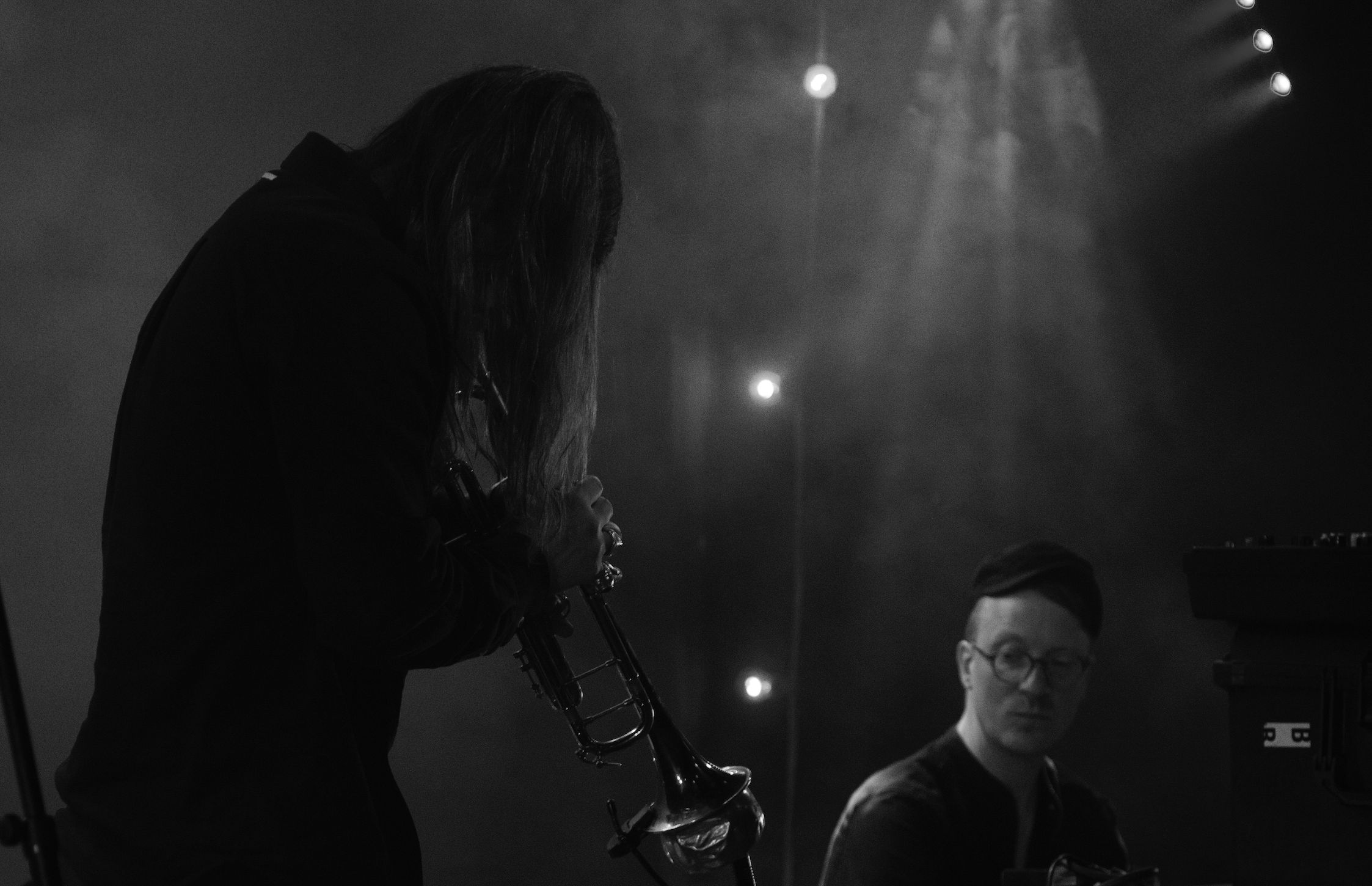
Individually, Andreas Tilliander and Goran Kajfeš have long been recognised as leading names in Swedish electronic music and jazz, respectively. Both have consistently pushed and transcended the boundaries of their genres. Tilliander has explored everything from techno, drones, and dub to clicks’n’cuts under monikers like TM404 and Mokira. Kajfeš has been a relentless innovator in jazz, playing a central role in bands such as Oddjob, Subtropic Arkestra, Tropiques, Nacka Forum, and Fire! Orchestra.
In 2005, you both received a Grammis award, a major music award in Sweden. That was also where the seeds of your collaboration were sown. Can you talk about this meeting, and why you decided to collaborate twenty years later?
Andreas: I guess we both came from making slightly more “strange” music. I had released just a few digital dub records on Mille Plateaux and Raster-Noton and was touring a lot outside Sweden. Nobody back home knew about my existence until 2004, when I made an album with more house-oriented music, though still with an experimental twist. I even had vocals on some tracks, and one single was featured on MTV. Suddenly I was awarded a Swedish Grammy for best electronic music that year.
I already knew about Goran and was a fan, so when I saw him that night, we started talking about doing a collaboration. This is something most musicians say to each other, I guess. Imagine if all those “we should record something together” conversations had actually resulted in something. I’m super happy we finally did record an album, even if it took 20 long years. I promise the next album will be out before 2045 though.
Goran: Well Andreas has basically said it all, I was already listening to the stuff he was releasing back then and really liked it, and I am very happy this dream finally came true.
The worlds of electronic music and acoustic have come together and drifted apart throughout the history of these genres. The methods and of doing this are incredibly diverse—using elements of each, deconstructing them, improvising, and so on. Can you talk about your particular approaches?
Andreas: We started performing live together during the pandemic when Goran curated a venue that allowed 50 people to attend. I prepared for weeks and created most of the music on my Clavia Nord Modular, but while waiting for a taxi to take me to soundcheck, I somehow managed to reset all the patches on my modular synth. Of course, this made me super nervous, but I trusted that Goran would make it work anyway, and the show ended up being far more improvised than planned. However, we both really enjoyed it, and our tiny audience did too. So when the pandemic was over, we started touring, which five years later resulted in the LP.
Goran: Basically, we continued doing these improvised concerts, not talking too much about the music beforehand or around the concerts, I think we enjoyed more the process of becoming friends and telling stories from our lives. I focused on not twisting my trumpet sound too much, leaving the electronic side to Andreas and letting our worlds meet and collide.
In April this year, you released a collaborative album entitledIn Cmin—an homage to Terry Riley and his In C. The album is also inspired by the moon, moonlight and the nocturnal. Can you talk about this record in terms of its aesthetic, conceptual inspiration and formal execution?
Goran: Well, it’s always hard to talk about music in those terms, because everybody who listens will have their own subjective experience. The main idea was to transform our improvised live sessions into an album without overproducing it—staying true to our performances, with all the moods and colours as we remembered them. We played around a lot live in the studio as well, not trying to make it a cerebral project but letting it unfold with a natural flow.
Instruments are important for your music—electronic ones for Andreas (with various hardware machines featuring prominently on your social media), and acoustic ones for Goran. How do you work with and approach instrumental work?
Andreas: Music really is the only thing that I enjoy spending my time on. Well, apart from hanging with my friends, family and dog, if they’re reading this. I tend to have a synth or drum machine with me wherever I go. Right now, Christmas is around the corner, and that always means transporting 25 kilos of instruments on the train to my mum’s flat. That said, instruments aren’t actually that important for me. What really matters. is making the music and, perhaps, the result. This means I’m constantly searching for new instruments, effects and ways of composing. Still, there are instruments in my studio that I’ll keep forever: the analogue seventies synth ARP 2600, my Buchla system, the Space Echoes, my Roland TB-303 and some fine Swedish drum machines.
Goran: I’ve been playing the trumpet for 45 years now, and there’s always something new to explore and discover—it’s basically a never-ending learning process of evolution. I tour a lot with my different bands (Subtropic Arkestra, Tropiques, Cosmic Ear, Oddjob, Nacka Forum and others) all year around, and I hope this keeps me from standing still musically. And of course, this collaboration with Andreas is an important part of that whole creative web.
Are you planning to collaborate in the future too?
Andreas: There’s a lot of unfinished material from the first record that I still enjoy—hours of improvisational trumpet playing from Goran and lots of electronic and acoustic loops I prepared for our live shows. I’d say that if somebody forced us to finish an album within a week or so, it would definitely be doable. But since the most fun part of making music is, well… actually making music, we’ll probably do a Tabula Rasa and start from scratch again. We both agree that we plan to work on a new album in 2026, though I know Goran is always super busy—and I guess I am too. My latest TM404 album was released during the pandemic, and I really miss touring with my 303’s and 606’s, so I need to record a new TM404 album during the next year as well. Plus, I’ve got big plans with the Kontra-Musik label boss too. More on that later…
Goran: We’ve only just started, so of course! I’m already very excited and curious to see where the next album will end up musically.
You are both seasoned, experienced musicians who have been on the scene for many years. Could you reminisce about the beginnings—what were your initial steps into your respective music careers, and how you look at their development over the years?
Andreas: My very first step in music was playing the violin. I guess I was about ten years old, but my interest in electronic music had already started, so I quickly realised that rather than playing other people’s music in a band or an orchestra, I wanted to create my own music using my own ideas. I sold the violin, and when I was twelve, I bought an Amiga 500—not to play video games, but to make music. That lasted for another couple of years, and then I began buying instruments whenever I had some money. The Korg MS-20 I bought when I was 16 is still one of my most treasured instruments in the studio. Like everyone else, I was a hardware freak in the nineties, but when I actually started releasing records at the turn of the millennium, my main sound source was the Clavia Nord Modular, which I recorded into the computer and used to make all my music “in the box”.
Goran: Both my parents are musicians, actually piano players, so I grew up with a lot of music at home. When I was ten, I started to play the trumpet and immediately fell in love with the instrument. I began with classical music, but early on I discovered jazz through my father, and we started improvising together. That was a big moment for me: I realised that improvising was the musical space I loved to be in and explore. Since then, I’ve been very dedicated to this art form, and I still love every second of being on stage, playing with great musicians and minds. It’s a blessing, and I’m still full of dreams and ideas waiting to be realised.
Interview Lucia Udvardyova
Photo Anna Drvnik